
Samples that interfere with endotoxin assays: a modern dilemma
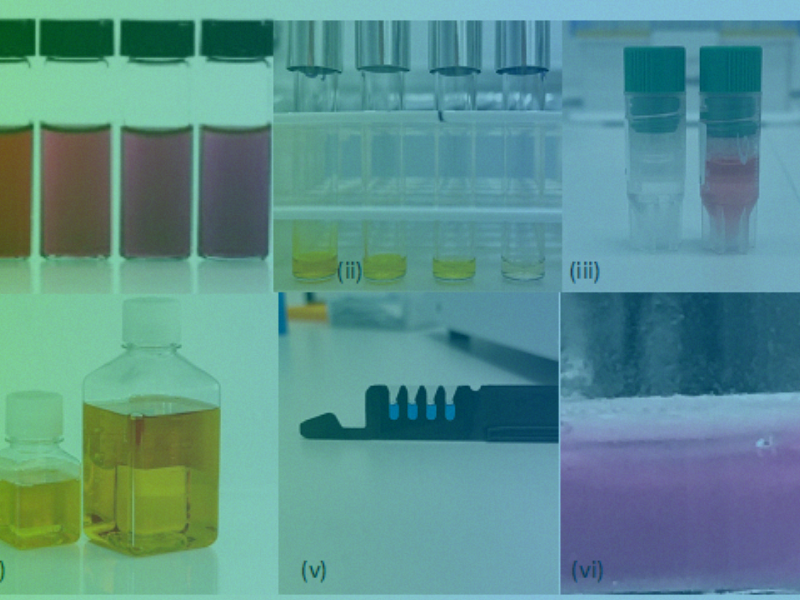
When your sample is coloured or cloudy, or contains particulates, whole cells or cell components, conventional kinetic chromogenic LAL or recombinant assays, operating around 400nm, can be subject to interferences that impact their sensitivity or even render the assay unusable. To a lesser extent this is also true for turbidimetric reagents. The reason why this should be a concern is that the number of products and samples possessing assay-interfering characteristics is growing rapidly. Historically, product and product-intermediates were uncomplicated, largely being small molecular weight drug molecules in WFI or formulated in simple buffer/excipient solutions, but this is no longer the case. Biopharmaceuticals now come in a wide range of different classes and formulations and many of these will possess one or more characteristics of an assay-interfering sample [1].
What’s the current approach for dealing with difficult samples?
By far the most common strategy for reducing optical interference is dilution and diluting samples up to 1/100 in LAL reagent water will often sufficiently over-come interference allowing a compliant endotoxin test to be performed [2,3]. However, with complex biopharma products making-up an increasing proportion of new therapeutics, aqueous-dilution to 1/100 is increasingly insufficient to negate sample interference. Whilst greater sample dilution will eventually result in an interference-free assay, this must come at a cost. For instance, when a product with an endotoxin limit of <0.1 EU/mL is diluted 1/100, an endotoxin test pass, would be <0.001 EU/mL. Given the limit of detection (LoD) (not limit of quantitation (LoQ) which would be higher) for nearly all FDA licensed LAL reagents is 0.001 EU/mL, consumable specifications seldom better than 0.005 EU/mL and there being a high-level of uncertainty in measurement at the low end of assay range, then even demonstrating a sample is <0.005 EU/mL can be very difficult to achieve with any degree of confidence. This is the dilution paradox. Analysis of a 1/100 dilution of a sample with an endotoxin specification of <0.25 EU/mL requires the diluted sample to contain <0.0025 EU/mL. Assuming even modest estimates of uncertainty in measurement, quoting an EU/mL concentration to the fourth decimal place is unacceptable, so a raw data of 0.0024 EU/mL would be reported 0.2 EU/mL and pass whilst data at 0.0025 EU/mL would be reported as 0.3 EU/mL and fail. Clearly, endotoxin levels extrapolated from dilutions of >1/50, that produce endotoxin concentrations at the bottom end of the assay calibration, can be at best inaccurate and at worst completely misleading.
The Pharmacopoeia’s approach to mitigate risk of patient harm from over-dilution of samples is to define a maximum valid dilution (MVD) calculation [4,5]. This calculation defines a maximum acceptable sample dilution, based on endotoxin limits and assay performance,

….where MVD = maximum viable dilution; L is the endotoxin limit for the product, C is concentration of the sample solution and 𝞴 is the sensitivity of the reagent.

…where K is the threshold pyrogenic dose of product per Kg body mass per hour and M is the maximum recommended dose of the product per Kg body mass.
The key interplay is between assay LoD and any requirement for sample dilution. The greater the sample dilution, the greater the uncertainty in the measured endotoxin concentration and the greater the error in the back-calculated endotoxin concentration in the undiluted sample (Figure 1). There are two possible solutions to this predicament - lower assay LoD or reduced the need for dilution. Given technical and regulatory hurdles, improving assay LoD is out of our hands so improving assay resilience, and therefore the need for significant dilution, is the only available option. This is exactly the approach adopted by CMD when developing our 𝜶BET® range of instruments.
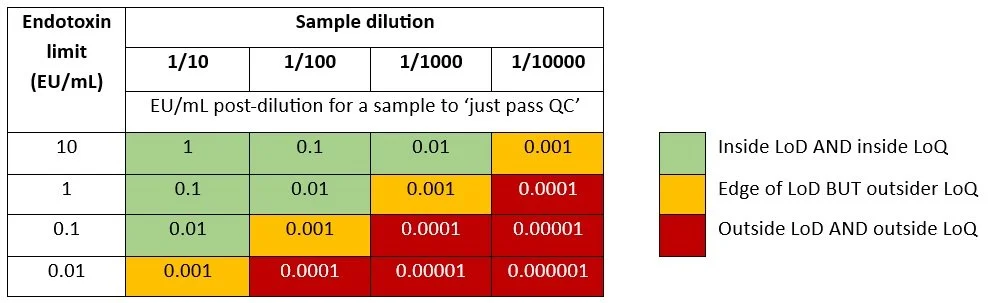
Figure 1. Interrelationship between endotoxin limit, sample dilution and limit of detection. When the endotoxin limit for a product is 0.1 Eu/mL or less sample dilution rapidly becomes impractical as a method for reducing assay interferences. (LoD = Limit of detection; LoQ = Limit of quantitation).
The αBET™ approach
The αBET™ system is an integrated and fully compliant endotoxin testing platform that is resistant to many types of optical interference that plague market-leading rapid endotoxin testing systems as well as tube and plate readers. αBET™ uses CMD’s proprietary magneto-optical detection technology to much reduce assay time-to-result with the added benefit that the assay possesses great resilience to common optical interferences.
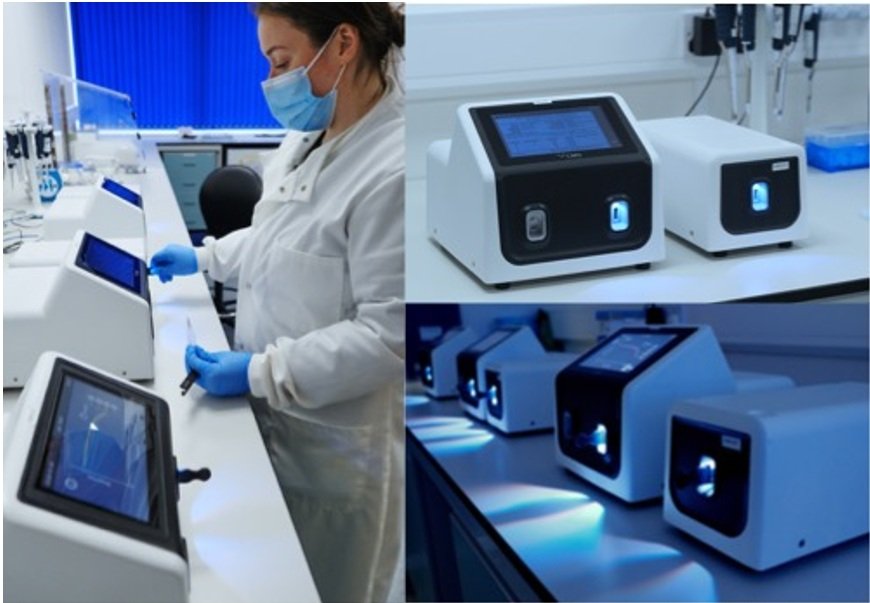
This unique level of robustness arises due to the replacement of typical 400 nm – 600 nm detection optics, used in nearly all other current endotoxin testing systems, with CMD’s proprietary 850 nm near infrared (NIR) magneto-optical detection. Biology has provided us with a unique window of opportunity in the NIR where very little absorbs and where the effects of light-scattering is reduced. This means that the αBET™ can perform a turbidimetric LAL assays in highly coloured samples, highly light-scattering formulations, nanoparticle colloids and even mammalian cell suspensions.
Typically, where a conventional system requires that the sample is diluted, the sample can be tested using αBET™ with a minimal reduction in sample dilution of one order of magnitude. Whilst this consistently delivers greatly improved precision, in some cases it will enable testing of previously untestable samples. αBET™‘s combination of assay speed and robustness can be transformative for those seeking to implement responsive in-process testing unlocking options for improving quality and consistency.
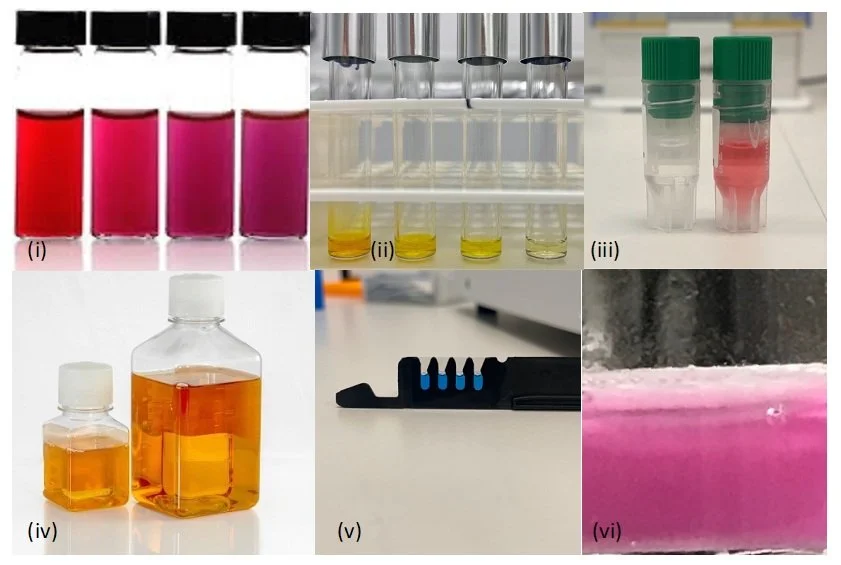
Figure 2. All samples in this figure have been successfully tested for endotoxin using αBET™ with Fujifilm Biosciences’ Pyrostar turbidimetric LAL reagent. Samples are either undiluted or diluted by 1/10. (i) gold nanoparticles of a various sizes; (ii) pNA of various dilutions; (iii) undiluted cell culture media; (iv) horse serum; (v) phenol blue ophthalmic solutions; (vi) mammalian cell suspension containing 5 x 10⁶ cells/mL
References
FUJIFILM Wako. Strategies for measuring endotoxin in difficult samples | FUJIFILM Wako
Wako LAL System. Tools, Standard Endotoxin, Interfering Factors | Wako LAL System
European Pharmaceutical Review. Bacterial Endotoxin Test using LAL: overcoming interfering factors
United States Pharmacopoeia (USP) ‘General chapter <85>: Bacterial Endotoxins Test’.
European Pharmacopoeia: EUROPEAN DIRECTORATE FOR THE QUALITY OF MEDICINES & HEALTHCARE (EDQM). (2023). ‘Chapter 2.6.14: Bacterial Endotoxins’, in European Pharmacopoeia (Ph. Eur.). 11th edn. Strasbourg: Council of Europe.